

A group of lawyers and stakeholders from Ondo State has protested the alleged exclusion of more than 60 per cent of the state’s coastal communities from the Lagos-Calabar Coastal Highway project.
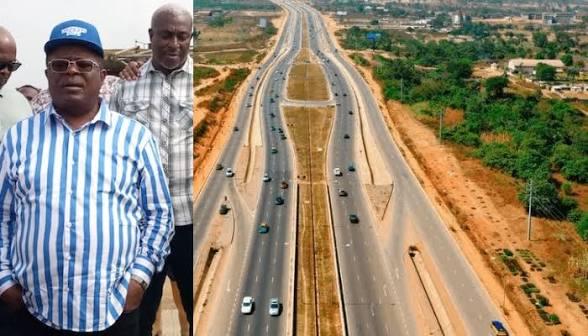
The group, under the Committee of Lawyers and Stakeholders, made the allegation at a press conference in Lagos on Thursday, accusing the Federal Ministry of Works, headed by Senator David Umahi, of altering the original coastal alignment in Ondo State in favour of an inland route through Edo State.
The committee, led by Dr Benson Enikuomehin, said the development had effectively denied several Ilaje coastal communities the benefits expected from the Federal Government’s flagship infrastructure project.
According to the group, communities including Ugbonla, Ilowo, Ilepete, Obe-Enikanoselu, Obe-Rewoye, Ikorigho, Jinrinwo, Awoye and Igho were originally within the proposed coastal alignment but had now been bypassed.
It alleged that while the highway maintained its coastal character in Lagos, Ogun, Delta, Bayelsa, Rivers, Akwa Ibom and Cross River states, the Ondo section had been diverted inland through Oke-Upare, Ovia North and Ovia West in Edo State before connecting to Gelegele and Warri.
The committee questioned the inclusion of Gelegele, which it said is located between 10 and 20 kilometres from the coastline, arguing that the move contradicted the fundamental purpose of a coastal highway.
It also rejected the Federal Ministry of Works’ alleged justification that the Ondo coastal route would be too expensive to construct.
The group claimed that the route from Ugbonla through the affected coastal communities to Escravos in Delta State would cover about 60 to 75 kilometres, while the alternative route through Oke-Upare, Ovia North, Ovia West, Gelegele and Warri would stretch between 130 and 150 kilometres.
It estimated the cost of the coastal route at between N240 billion and N450 billion, against between N970 billion and N1.5 trillion for the proposed inland detour.
The committee further cited the 2010 Ugbo-Oghoye Road project awarded by the Niger Delta Development Commission as evidence that the Ilaje terrain was technically navigable. It said the 40-kilometre project was awarded for N19.4 billion, with the Bureau of Public Procurement issuing a certificate of no objection.
The stakeholders maintained that they were not opposed to Edo State benefiting from the coastal highway but insisted that such benefit should not come at the expense of Ondo’s coastal communities.
They also raised constitutional concerns, alleging that the exclusion of the Ilaje communities amounted to discrimination contrary to Section 42 of the 1999 Constitution.
The committee consequently appealed to President Bola Ahmed Tinubu to intervene and order a review of the alignment, insisting that the project should remain genuinely coastal through Ondo State.
It also challenged the Minister of Works to explain why the highway should allegedly become an inland road only in Ondo State while retaining its coastal alignment in other states.
The group said the intervention of the President was necessary to prevent what it described as the marginalisation of the Ilaje people and to ensure that the objectives of the Lagos-Calabar Coastal Highway were achieved.

