

There are moments in history when lies wear the garment of truth so boldly that the unwary almost mistake one for the other. In those moments, clarity becomes both a duty and a weapon. Such is the case with the recent controversy surrounding the Ondo land-grabbing saga, where emotion, deceit, and desperation have danced too closely around the fire of public opinion.
At the heart of this story is one Mr. Ojo Ajisafe, a man whose name now echoes in conflicting tones. To some, he is a land grabber; to others, a victim of political manipulation and orchestrated character assassination. The truth, as always, lies deeper than headlines and beyond the noise.
When I first encountered Abayomi Adebayo “Yomisaint”’s rejoinder defending the government’s anti-land-grabbing crusade and condemning Ajisafe as a serial offender, I found the narrative compelling, detailed, and disciplined in its delivery. It painted Governor Lucky Orimisan Aiyedatiwa’s government as one firmly anchored on justice, transparency, and the rule of law. It highlighted Dr. Olukayode Ajulo’s reformist zeal as Attorney General, his passion for legal sanity, and his intolerance for impunity. It positioned Ondo State as a model of governance where justice, once blindfolded by influence, now sees clearly.
Yet when one listens to the other side, the voices of those who have watched events unfold from closer quarters, one begins to see the shades between black and white. Those who accuse Ajisafe seem to have inherited their convictions from whispers, not evidence, from a crowd’s verdict, not the scales of justice.
For example, reading through Adebayo’s piece, one might easily forgive his confidence, for it is clear he speaks not from malice but perhaps from ignorance, hearsay, or the sincerity of a bystander fed on half-truths. But how do we reconcile a situation where a multitude’s accusation becomes a man’s conviction? When fifty-two petitioners, many of whom now secretly return to beg the same man they once defamed, are the pillars on which the castle of condemnation was built?
It may interest the discerning public to know that a quarter of those who once labeled Ajisafe a land grabber have since gone back to him quietly and privately to pacify and ratify their land documents. They confessed they had been misled, manipulated by powerful interests, and guided by the nose into mob judgement. Their signed documents of reconciliation, now in existence, may one day tell a story far different from the one currently trending.
Let us trace the roots of this saga. It began when a petition was written to the Office of the Attorney General and later seconded to the House of Assembly. About fifty-two land claimants appended their signatures, accusing Ajisafe of parading fake judgments and grabbing land. The petition found its way to the then Commissioner of Police, Mr. Wilfred Afolabi, who, eager not to offend the political gods, threw Ajisafe into detention, a man imprisoned not by law but by influence.
Fate, however, has a way of rewriting injustice. When Mr. Femi Akinbinu approached the CP to seek administrative bail, he met resistance. Coincidentally, the CP received a call from the Speaker of the House, informing him that the Governor’s interest had entered the matter. After that call, the CP’s countenance changed, and the message was clear, Ajisafe’s fate was sealed. Akinbinu was told to bring the King as bail surety, a request so absurd that he walked away in silence.
But destiny took another turn. Afolabi was abruptly removed, and a new Commissioner, Mr. Wale Lawal, assumed office. Upon reviewing the case, Lawal did what many in uniform fear to do, he freed the innocent. He ordered a verification of all the judgments Ajisafe allegedly forged, sending them to the issuing courts. The results were shocking; every judgment came back authentic, bearing the weight of legal validity. The damning police report that followed exonerated Ajisafe entirely.
Those who once shouted guilty fell into uneasy silence. It became clear that the system had been manipulated not by Ajisafe, but against him. And then, in quiet corners, whispers began to rise, suggesting that perhaps the Governor himself had been misled, unaware of the darker machinations beneath the surface.
Meanwhile, Mr. Akinnuoye, also known as Adaja, the man central to this conflict, was himself under police investigation at Zone 17, Akure, for identity theft and a machete attack. When the police concluded their investigation, he absconded. He was later arrested near a courthouse in connection with another criminal matter altogether. These are the missing threads conveniently omitted in public reports.
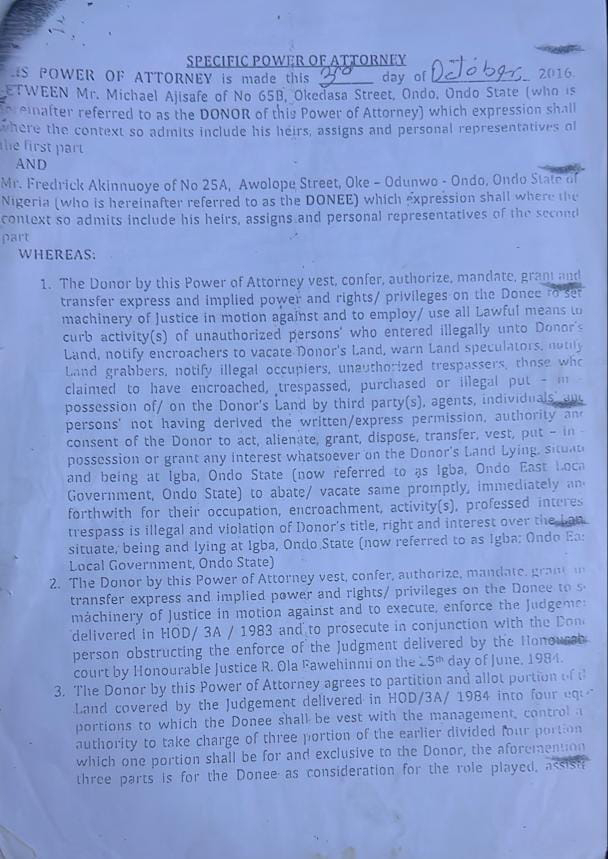
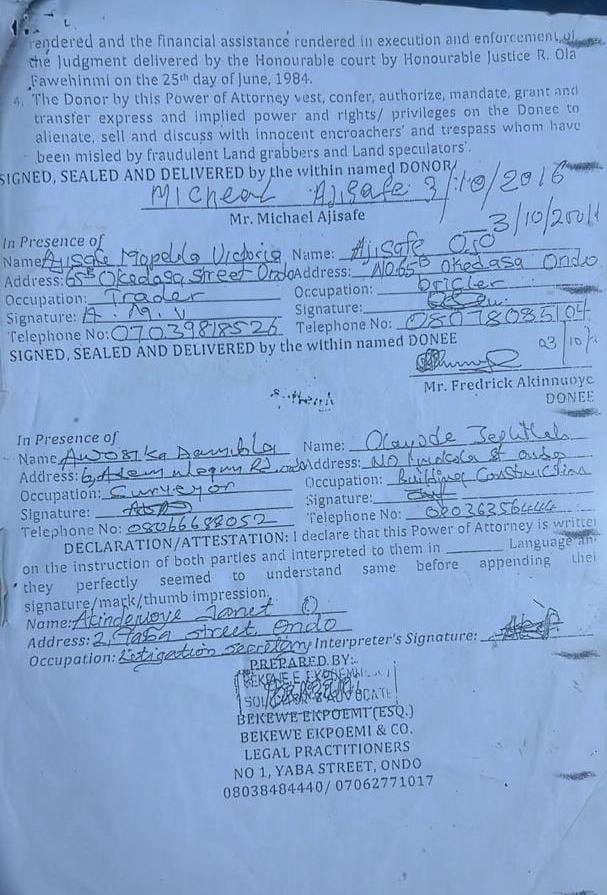
But the story does not end with land. It bleeds into the realm of personal tragedy, into the strange spiritual theatre orchestrated by Akinnuoye, who had the Power of Attorney from Ajisafe’s father. Let it be placed on record that the only legitimate link between Ajisafe and Akinnuoye was the Power of Attorney, an agency relationship, not a familial bond. The documents were properly signed by Ajisafe’s father, with Ojo signing as a witness, and became operative until the moment of his father’s passing. Nowhere does it infer kinship, bloodline, or hereditary ties. Yet Akinnuoye, in a web of manipulation and deceit, exploited the frailty of a dying man to advance his own interests.
Witnesses recount how Akinnuoye, a herbalist like the elder Ajisafe, exploited their shared faith in spiritual traditions. In a chilling episode, he sat the dying man in a chair, filmed him in agony, and coerced him into pronouncements meant to serve Akinnuoye’s schemes. He claimed he was battling three thousand demons sent to destroy the family, boasting that his oracle had already slain two thousand, leaving a thousand yet to conquer.
He brewed dark concoctions from unspeakable things, even the old man’s excreta, convincing him it was the only path to survival. In that delusion, the dying father clung to him, refusing to sign any documents until his son returned. When Ajisafe rushed home from Bayelsa, where he worked as a humble bricklayer, he found his father at death’s door, frail, manipulated, and surrounded by deceit. The same Akinnuoye who claimed to be fighting demons was the one draining the man’s spirit, trying desperately to seize his estate before the final breath.
In that moment, as the father exhaled his last, the Power of Attorney remained in effect until his death, and Akinnuoye’s scheme, though advanced, could not distort the true relationship of agency defined by law. The family’s oral testimonies, documented and preserved, all align on one truth, that Akinnuoye’s supposed guardianship was fraud draped in ritual theatre, greed disguised as oracle.
Today, this same web of deceit bleeds into the public conversation about land and justice. What began as a family’s private betrayal has now become a public spectacle. But the discerning eye must see the thread that ties it all together, power, manipulation, and the desperate will to twist the truth when one’s empire of lies begins to crumble.
Let the record show that the Power of Attorney remains the single lawful bond between Ajisafe and Akinnuoye, a simple agency relationship, not the filial connection the impostor now claims. And let the world also know that justice, no matter how delayed, never dies in silence.
Ondo State stands today at a moral crossroads. On one side lies a government determined to uphold justice, on the other, the haunting possibility that sometimes even noble reforms may be weaponised by those who whisper closest to power.
The people deserve the full truth, not the edited version, not the politically convenient one, but the truth that bears both shadow and light.
In the end, truth has no panic. It may walk slowly, but it never loses its way.

